






- April 21, 2026
Top 5 lessons learned at the GRESB AP exam
For some of us striving for excellence is not an operational choice, it simply defines who we are.
Here at E.S.G. Solutions everybody involved in the delivery of our Clients’ GRESB projects has to demonstrate their competence in this benchmarking tool, regardless of their position within the company.
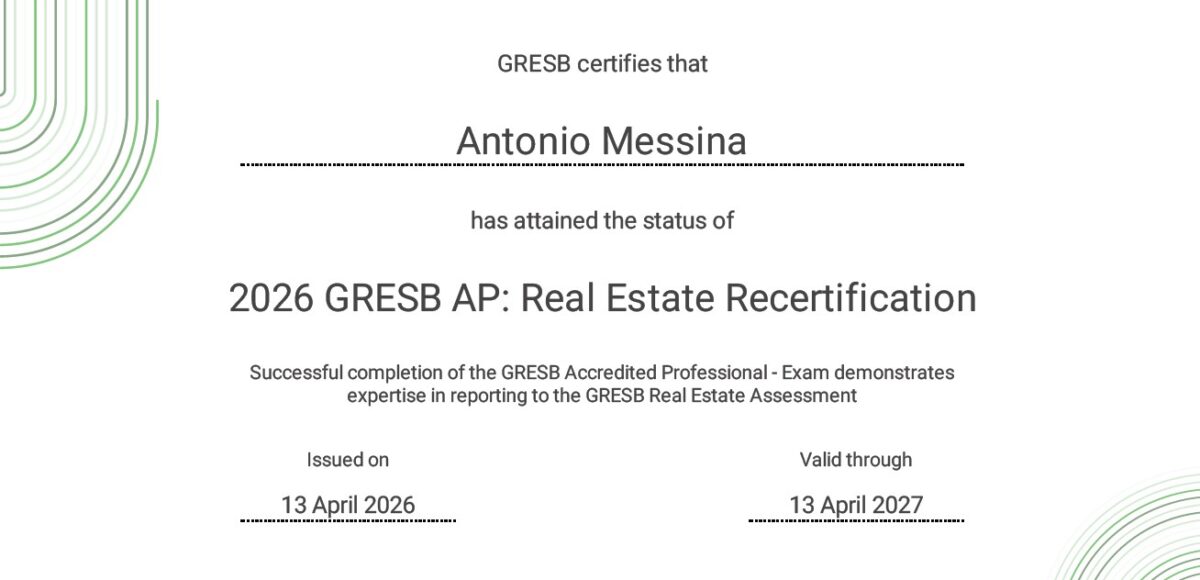
Our Managing Director Antonio Messina has recently updated his Accredited Professional credentials for 2026/27 and would like to share with our readers the top-5 lessons learned from the recertification exam, that the industry may find helpful prior to this year’s submission.
- Climate risk agenda. As announced last year (see our blog article here), the scoring weight of the four indicators RM6.1-RM6.4 on climate risks’ identification and impact assessment increased from 0.5 to 1 points each. Assuming that an entity earned full points for its GRESB 2025 reporting and is not going to change its selections this year, you should not expect to automatically receive full points in 2026! In fact, the entity cannot predict its new score because evidence validation outcomes may differ from those applied previously. For example, Indicator RM6.1 requires evidence of the entity’s systematic risk identification process and entity-level outcomes, which is subject to manual validation, as per the Standards Methodology Insights Report section of new GRESB Guides.
- Embodied carbon agenda. GRESB requires reporting of measurement and disclosure practices for all of an entity’s development projects, plus emission data for those projects completed during the reporting year. It should be noted that the quantitative number representing total/absolute embodied carbon emissions may relate to the previous reporting year, not necessarily to 2025 then, and the three points available for percentage of projects for which emissions were measured are not awarded based on the number of individual projects but proportionally, using the percentage of their gross floor area.
- GHG Scopes agenda. Emissions from landlord-controlled tenant spaces, for example high-rise buildings where the landlords oversee operational measures (e.g. lights, applicances, HVAC, etc.), are now classified as Scope I and II, while historically they used to be Scope III because the previous classification was based on the location of energy consumption (within tenant-dedicated areas), diverging from the GHG Protocol’s operational control approach, which attributes emissions based on who has the authority to introduce and implement operating policies. GRESB cannot identify a precise scoring impact because only certain GHG emissions are subject to re-classification and emission factors may be inconsistent year-over-year.
- Sustainability reporting assurance agenda. Provided that third-party assurance/verification in the context of sustainability disclosure should cover all of the sustainability-related information, it should be noted that evidence validation practices in 2026 will not apply this level of scrutiny i.e. GRESB will only seek to confirm that the third-party review covers a single sustainability topic (e.g. all GHG emissions data). Rules may change in the future.
- Data estimation agenda. When actual data is partially unavailable, participate may use GRESB estimation rules to fill the gaps, provided that estimated data doesn’t exceed a three-month cap across both reporting years (i.e. 2024 and 2025) and 20% of the total period for which actual data is available. It should be noted that estimation of asset-level data is only allowed when the available data covers the same performance aspect (i.e. energy, GHG, water, waste), the same area type (e.g. Base Building, Tenant Spaces, Whole Building) and the same utility type (e.g. fuels, electricity, district heating and cooling). Conversely, GRESB would not allow estimation of electricity data based upon fuel (e.g. natural gas) consumption figures.
If you would like to discuss with one of our AP experts about this year’s GRESB submission, please don’t hesitate to be in touch at info@esgsolutionsltd.com or +442045268272.