





- December 5, 2025
How the new GRESB roadmap keeps driving sustainable value
There’s a reason why E.S.G. Solutions has been a GRESB Partner since its very first year of trading: we believe in the common mission, simple but powerful, to help investors and fund management teams create sustainable real estate and infrastructure assets that deliver lasting value.
Since 2009 the GRESB Standards have been providing the basis for the systematic assessment of the management and performance of real asset companies and funds around the world, thus defining the information that real asset investors and managers need in order to understand, benchmark and improve performance – recognising and rewarding assets that are clean, efficient and resilient. These assets set the standard for better investments and a better world.
Although 2026 is going to be very much a year of transition, to maintain relative stability in both the Real Estate and Infrastructure Standards, there are a number of updates planned in the GRESB roadmap which are being proposed, to execute on the Foundation’s longer-term vision toward rewarding measured, real-world performance.
The new Standards offer multi-year implementation plans for key issues, including energy efficiency, decarbonisation planning and net-zero alignment, physical climate risk and resilience, embodied carbon and many other material topics that continue shaping a more sustainable future for the entire real asset industry.
2026 GRESB Real Estate Standards Updates and the Road Ahead
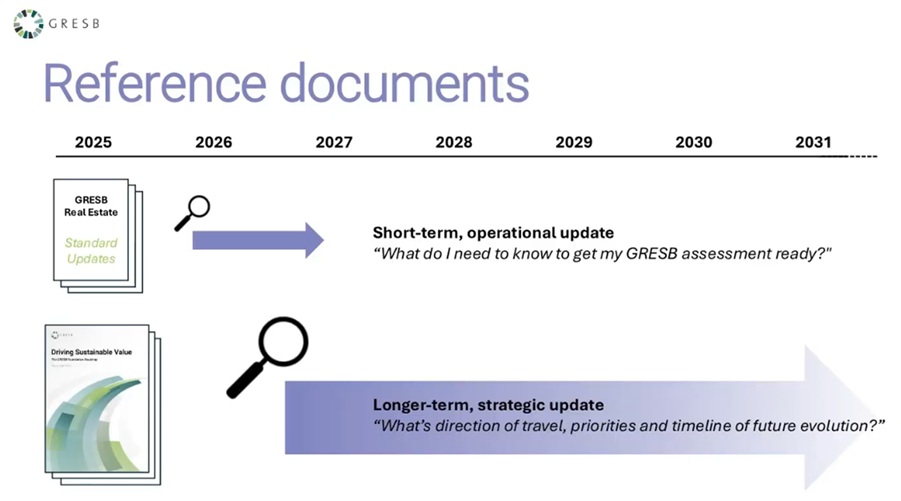
On Tuesday 2nd December 2025 GRESB clarified how the 2026 Real Estate cycle is being framed as a stepping stone toward a more stable, performance-driven assessment model. Positioned as both an update and a strategic orientation, the webinar led by Sarah Welton, Nicole Tramper and Charles van Thiel clarified identified the principles guiding GRESB’s development over the next decade.
1) Next year will mark a shift from year-to-year adjustments toward a more structured approach, giving reporting organisations a clearer sense of how the framework will evolve as GRESB is progressively going to put stronger emphasis on performance. GRESB confirmed that major updates will now occur every three years, with the next significant release planned for 2028. This aims to enhance consistency, reduce unpredictable year-on-year changes and allow organisations more time to integrate new requirements.
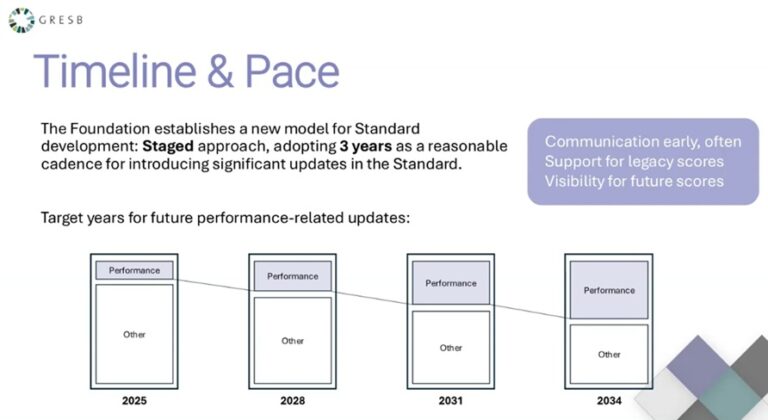
2) The long-term ambition is for the 50% of the assessment to be performance-based, with increased focus on asset-level outcomes rather than policy documentation. To support this, GRESB is adopting a dual approach to defining performance:
- Absolute performance, such as energy intensity or emissions intensity;
- Relative performance, reflecting improvements over time and comparison with peers. This is a key new feature in a context where the most successful business strategies are indeed based on creating added value from under-performing assets – hence it makes perfect sense to reward behaviours which generate such economic, social and environmental impacts!
This shift aligns GRESB more closely with real-world environmental outcomes and global reporting expectations.
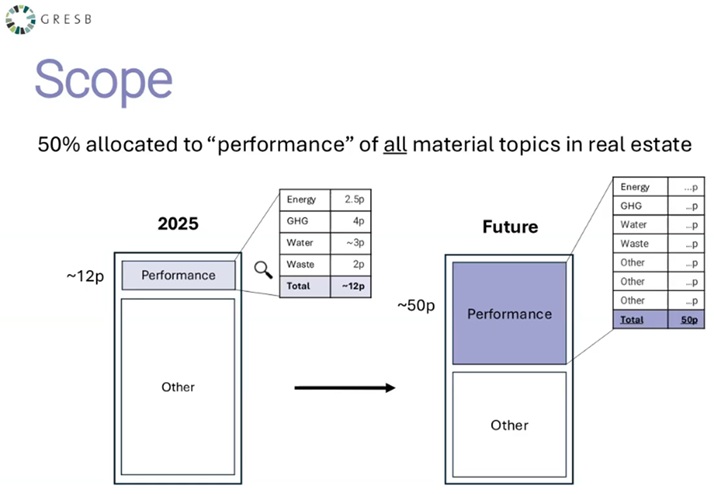
3) We have also learned about initial prioritisation of energy & GHG metrics, expected to make up around a quarter of the assessment across all asset classes. Weightings for other ESG topics (e.g. climate resilience, water, embodied carbon, waste, biodiversity, human capital, halth, pollution) are still being refined, with sector-specific differentiation likely to ensure materiality is properly reflected.
4) GRESB has then disclosed their future plans to streamline reporting requirements by improving data quality and reducing the volume of information that participants must manually provide. The intention is to concentrate effort on inputs that directly influence performance scoring, without compromising on data accuracy.
Our thoughts
For organisations navigating ESG reporting, the roadmap laid out by GRESB provides a clearer framework for long-term planning, internal prioritisation and strategic alignment. With performance taking a more prominent role, a transition year in 2026 and a move to three-year development cycles, GRESB is shifting toward a system that better reflects real-world outcomes while reducing unnecessary reporting burden.
As the industry prepares for the next assessment cycle, these updates provide a clearer understanding of where GRESB is heading and how organisations can position themselves for the changes to come.